

The Reliability of BEA Statistics
Improvements to Estimates of Selected Key Statistics Over 25 Years
U.S. Bureau of Economic Analysis (BEA) data users appreciate many features of BEA's economic statistics. Impactful measures like gross domestic product (GDP), personal income, and the balance on the current account are valued for their accuracy, timeliness, and usefulness. A key feature that often gets overlooked, however, is BEA's estimates are continually improving. This sustained progress is what allows BEA to deliver the most accurate measures of U.S. economic activity in the timeliest manner.
BEA updates its statistics on a regular cycle to continually improve the reliability of the estimates. This well-defined updating process allows BEA to incorporate previously unavailable data, improved methods, and changes in definitions or classifications on a predictable cycle.
Consider source data availability. Source data is the “raw” information from surveys, administrative records, and private companies used by BEA to produce estimates of economic activity. It can take months or even years for the most comprehensive source data—such as tax records—to become available. Waiting for such final source data before publishing an estimate makes the estimate much less useful and relevant. Just imagine if GDP only came out every 5 years when data from the Economic Census became available.
Instead, due in part to its rigorous updating process, BEA produces the world's timeliest estimate of GDP—the advance estimate—published just 30 days after the end of a given quarter. Then, as more complete source data become available, they can be incorporated into the second and third estimates of GDP (60 and 90 days after the end of the quarter, respectively) and into the annual update every fall and the comprehensive update typically every 5 years.
Updates to other BEA statistics, such as state personal income, may follow a different cadence, but they use the same updating process to incorporate more complete source data and updated methods as they become available.
This updating process is crucial to improving data quality and achieving a good balance between accuracy and timeliness across BEA's entire suite of economic statistics. In other words, these statistical updates help ensure the accuracy and reliability of data used to guide decisions made by policymakers, businesspeople, and households.
To ensure all estimates—initial to final—can confidently be used in this decision-making, BEA periodically assesses the reliability of its statistics. These formal and informal assessments have consistently shown early estimates are indeed reliable. That is, updates between estimates are generally small and do not substantively change the overall picture of economic activity.1 In fact, the reliability of many key indicators, including GDP, has been improving over time.
The remainder of this article provides more detail on the pattern and magnitude of revisions between the initial estimates and subsequently updated estimates for a handful of key statistics—growth in inflation-adjusted GDP, exports and imports of goods and services and income payments and receipts, and personal income. Table 1 illustrates the initial quarterly update cycles for each of these indicators.
| Indicator | Estimate cycle initiated | Estimate cycle complete | |
|---|---|---|---|
| Gross domestic product | National | 30 days after quarter end | 90 days after quarter end |
| State | 90 days after quarter end | Annually, with the annual update | |
| International trade | Imports | 80 days after quarter end | 160 days after quarter end |
| Exports | 80 days after quarter end | 160 days after quarter end | |
| Personal income | National | 30 days after quarter end | 90 days after quarter end |
| State | 90 days after quarter end | 180 days after quarter end | |
Note. All timelines are approximate.
U.S. Bureau of Economic Analysis
Focusing on the initial update cycle highlights the effect of incorporating more complete source data, since updates to methods or definitions are usually brought in during annual or comprehensive updates. For national-level statistics, the effect of more complete source data is calculated as the average of the initial quarterly updates each year. For state-level statistics, in charts 2 and 6, the quarterly updates for each state and the District of Columbia are first averaged for a given year, then the weighted average across states is calculated for that year. The average across states is weighted to account for the different size of each state economy.
Gross domestic product is BEA's most prominent economic indicator. The public, policymakers, and businesses closely watch growth in real GDP every quarter to help guide decisions and better understand the state of the U.S. economy; therefore, ensuring reliable GDP estimates is critical to BEA. Previous assessments of the reliability of real GDP growth have shown updates between estimates are generally small and do not substantively change the overall picture of economic activity.
Chart 1 illustrates the average difference in percentage points between the initial, or advance, estimate of real GDP growth, released 30 days after the end of the quarter, and the third estimate, released 90 days after the end of the quarter, for 2000–2024. The size of updates has been trending lower over this period, indicating the reliability of real GDP growth estimates has been improving over time, with notable improvements since 2014.
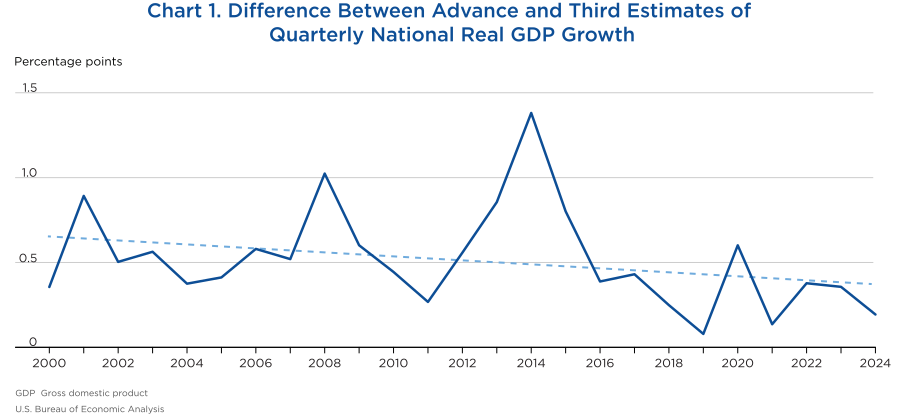
Updates to real GDP growth between the advance and the third estimates averaged 0.52 percentage points between 2000 and 2024.2 That is, over these 25 years, more complete source data expanded or contracted BEA's estimates of real GDP growth on average by about half a percentage point per quarter.
BEA also produces inflation-adjusted GDP growth estimates for all 50 states and the District of Columbia. These have been produced quarterly since 2016 and are updated on a different cycle than national GDP.
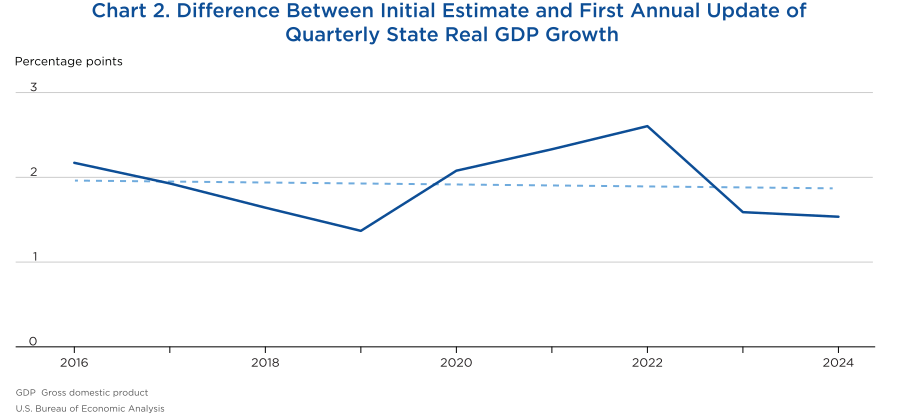
For states, initial estimates are published concurrently with the third estimate of national GDP (90 days after the end of a quarter). Unlike national GDP, the GDP by state estimates are then next updated on a yearly basis with BEA's annual update of the Regional Economic Accounts, as more complete source data become available. Chart 2 plots the weighted average across states of the average update between the initial state estimates and the annual state update.
Between 2016 and 2024, this average update across all states and the District of Columbia was 1.92 percentage points, meaning quarterly real GDP growth across the 50 states and the District of Columbia is impacted less than 2 percent on average as more complete source data are incorporated. As shown in chart 2, the reliability of average real GDP growth estimates across 50 states and the District of Columbia has improved over time, as indicated by the downward trend in the size of updates.
The U.S. International Transactions Accounts (ITAs), formerly known as the balance of payments, have been produced by BEA since the 1920s. The ITAs are a comprehensive record of transactions between U.S. residents and foreign residents, presented in current, or noninflation-adjusted, dollars.
While the ITAs are comprised of many different statistical series, this article will focus on two of the most visible: (1) imports of goods and services and income payments and (2) exports of goods and service and income receipts. These are the major series within the ITAs that help determine the balance on the current account—the featured net measure in the ITAs of transactions between the United States and the rest of the world.
The update cycle for the ITAs differs from that of both national and state GDP. The initial ITA estimates for a quarter are released approximately 80 days after the final day of that quarter. The first update to a given quarter's estimates (i.e., the second estimate of the ITAs) occurs 3 months after the initial estimate, with subsequent updates incorporated throughout the year, including on a yearly basis in BEA's annual update of the International Transactions Accounts. In what follows, the focus is on updates between the initial and second estimates of the ITAs, within the first 6 months after the end of a quarter.
Chart 3 displays average updates over the period 2000–2024 for quarterly growth in imports of goods and services and income payments. Although there is some volatility in the averages over time, the average updates between the initial and second estimates are relatively stable.
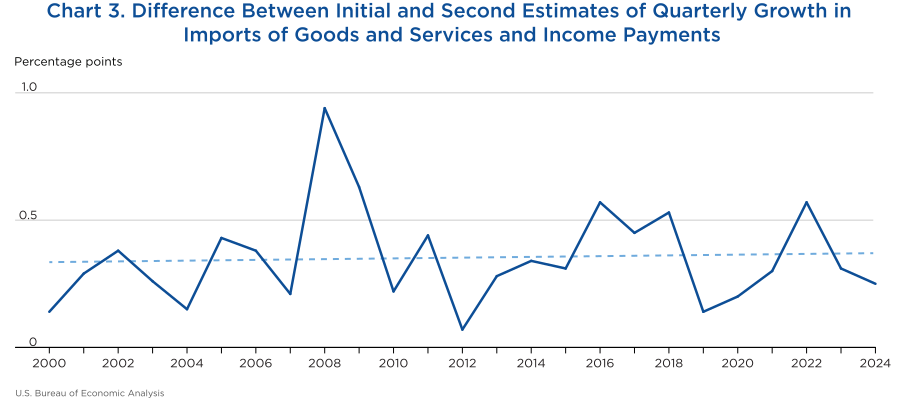
The average update over the 2000–2024 period for quarterly growth in imports of goods and services and income payments was 0.35 percentage points. Therefore, quarterly growth in imports of goods and services and income payments expanded or contracted by about a third of a percentage point during the initial update cycle.
Moving to the exports side, chart 4 plots the average updates over that same period.
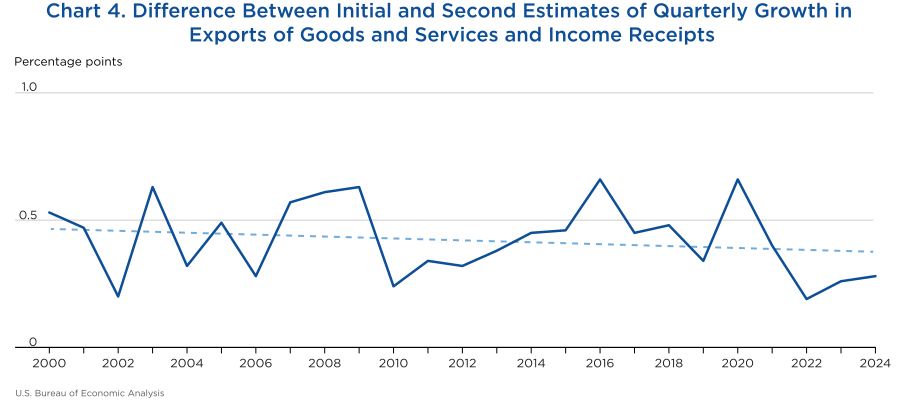
The average update for exports of goods and services and income receipts from 2000 to 2024 was slightly higher than imports, at 0.43 percentage points. However, similar to imports, the initial update cycle expanded or contracted quarterly growth in exports of goods and services and income receipts less than half a percentage point. Average updates between the initial and second estimates of the ITAs for exports of goods and services and income payments declined over the 2000–2024 period.
BEA's estimates of personal income complement GDP and provide an alternative perspective on U.S. economic activity. Both national and state personal income estimates have been produced since the 1930s. National personal income estimates are produced both monthly and quarterly and are presented in current, noninflation-adjusted dollars. This article focuses on the quarterly statistics, which are updated on the same cycle as quarterly GDP.
Chart 5 plots the average annual updates to national personal income growth from 2000 to 2024 between the advance and third estimates.
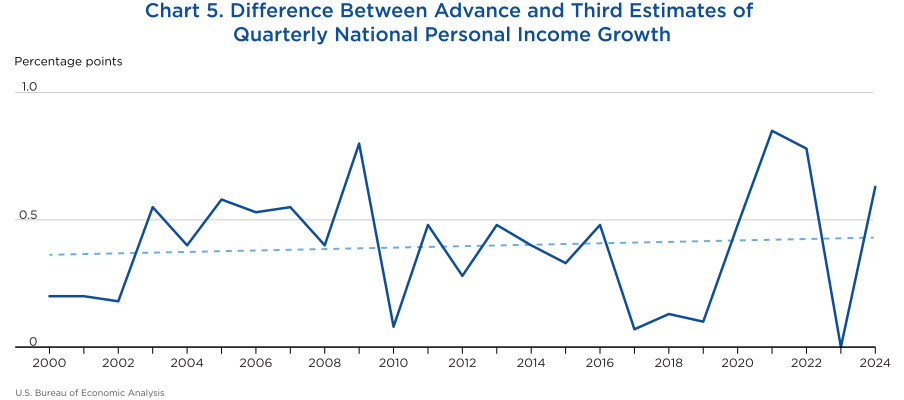
The average updates are relatively flat, though there is some volatility in the series. Updates to national personal income growth between the advance and third estimates averaged 0.4 percentage points over the 2000–2024 period, resulting in a change in the quarterly growth rates of less than half a percentage point on average.
State personal income is one of the most important subnational economic statistics produced by BEA. These estimates are used to allocate over $600 billion dollars in federal funding across states. The update cycle for state personal income differs from national personal income and state GDP. Initial estimates are published concurrently with the third estimate of national GDP (90 days after the end of a quarter). These estimates are updated 90 days later (second estimate), when the initial state personal income estimate for the subsequent quarter is published.
Chart 6 displays the average across states of the average annual update between the initial and second estimates of personal income for each state and the District of Columbia. As with state GDP, the average across states is weighted to account for the different size of each economy.
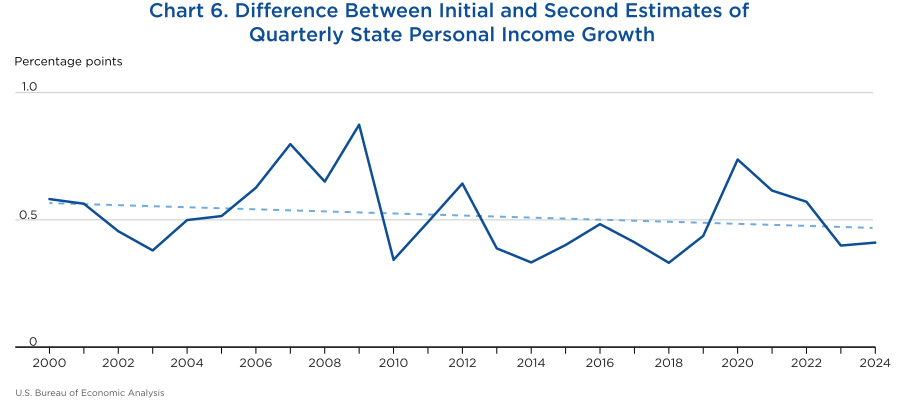
The average size of the update across states between 2000 and 2024 was 0.52 percentage points, meaning quarterly state personal income growth contracted or expanded by just over half a percentage point on average during the initial update cycle. And as shown in chart 6, average annual updates across states have trended down over time, indicating reliability for state personal income growth is improving.
BEA data users value both accuracy and timeliness. Our rigorous updating process is crucial to achieving a good balance between accuracy and timeliness across BEA's entire suite of economic statistics. The updating process also ensures BEA estimates are continually improving.
In recent years, this improvement has included improved reliability of key economic indicators such as GDP. In fact, as shown in chart 7, average updates to GDP have declined over the last 25 years—and have more than halved since the 2010–2014 period.
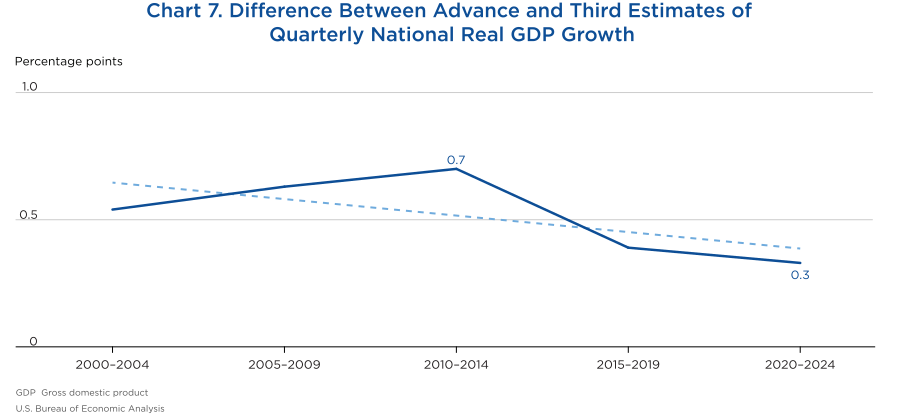
But improved reliability isn't limited to national GDP. As shown above, BEA has made progress in improving the reliability of a variety of economic indicators across its National, International, and Regional Economic Accounts.
This continual progress is what allows BEA to deliver the most accurate measures of U.S. economic activity in the timeliest manner.
- For more information, see Dennis J. Fixler, Eva de Francisco, and Ian Schaaf, “Revisions to Gross Domestic Product, Gross Domestic Income, and Their Major Components,” Survey of Current Business (August 27, 2024) and Thomas Anderson, “Reliability of the International Accounts,” Survey (December 17, 2024).
- For more information on the update cycle for GDP and related statistics, see “GDP Update Cycle in Focus,” Survey (September 18, 2023).
Suggested citation
Vipin Arora and Rebecca Pocase, “The Reliability of BEA Statistics: Improvements to Estimates of Selected Key Statistics Over 25 Years,” Survey of Current Business (May 19, 2026), https://doi.org/10.66137/XOAY5205.
