

BEA's Economic Accounts, Part 1
The Foundation for Today's Most Essential Economic Statistics
U.S. Bureau of Economic Analysis (BEA) economic accounts help Americans monitor and analyze the economic performance of our country, identify trends and patterns in the economy, and make informed decisions. The accounts also serve as a tool for international comparisons of economic performance and for understanding the interconnectedness of national economies.
From humble historical beginnings, to their initial development in the United States in the early 1900s, through their continual improvement over time, BEA's economic accounts have grown into the foundation for some of the world's most important economic information.
So much so that Arthur Burns, former Chair of the Federal Reserve Board, remarked back in 1971 that “the widespread use of the national income accounts as an integrated system for measuring and evaluating economic developments is an achievement of the first magnitude.”
Yet, it's not the statistics themselves that constitute this achievement, but rather the system of accounts from which the statistics are derived.
Our economic accounts—the International Economic Accounts (IEAs), the National Economic Accounts (NEAs), and the Regional Economic Accounts (REAs)—are all pieces of a world-leading system that has been developed, tested, and refined for over 100 years (chart 1).
That development began in 1923 with our first official estimates of the balance of payments, took a leap forward in 1947 with publication of our first complete set of national income and product statistics, and relentlessly continues.
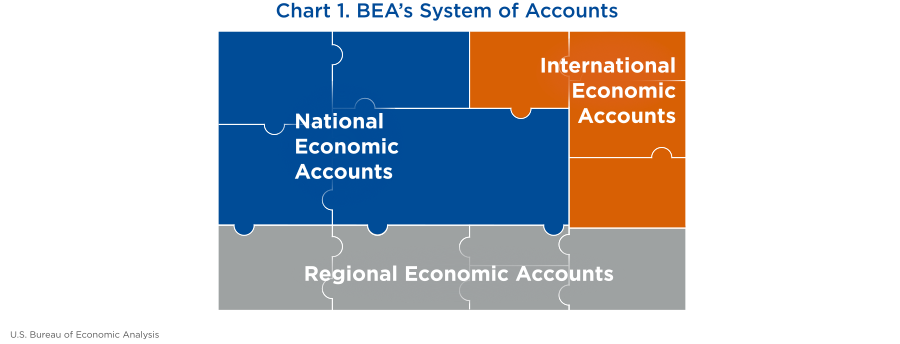
The collective system of these three sets of accounts provides the methodological framework for measuring the U.S. economy. The system has three distinguishing characteristics—comprehensiveness, integration, and consistency.
Our economic accounts provide a comprehensive picture of the U.S. economy. More specifically, they provide the structure to measure U.S. economic activity, including the production of goods and services, income earned, and expenditure incurred by households, businesses, and government. This breadth is a major reason the statistics produced by BEA are invaluable tools for policymakers, Wall Street, business leaders, entrepreneurs, and regular Americans.
In addition, BEA's economic accounts are integrated through connections with each other. This means the consequences of a transaction recorded in one part of the accounts will be reflected throughout them all. Integration makes discrepancies between different parts of the accounts easier to identify and resolve, improving data quality, and allows for a better understanding of the links between different parts of the economy.
Finally, our accounts fit together—their definitions and methods are consistent with each other. This makes it easier to compare economic statistics across industries, across countries, and over time. It also results in more accurate statistics. According to Anne Carter and Nobel laureate Wassily Leontief: “consistency constraints ensure greater accuracy throughout the system.”
These characteristics of our system of accounts—comprehensiveness, integration, and consistency—are the foundation that supports our relevant, timely, and reliable statistics. The system of accounts also helps to ensure that our methods are transparent and rigorous, and that they meet the highest standards. But what specifically is in each account, and how exactly are they integrated (chart 2)?
The IEAs provide timely, accurate, and relevant economic statistics that allow policymakers and other decision-makers to understand the role of the United States in the global economy. They consist of four major building blocks—the International Transactions Accounts (ITAs), the international investment position (IIP), statistics on the activities of multinational enterprises (AMNE), and international services statistics.
The ITAs and the IIP illustrate an integrated and comprehensive view of U.S. economic engagement with the rest of the world, while the international services and AMNE statistics provide detail on dimensions of that engagement.
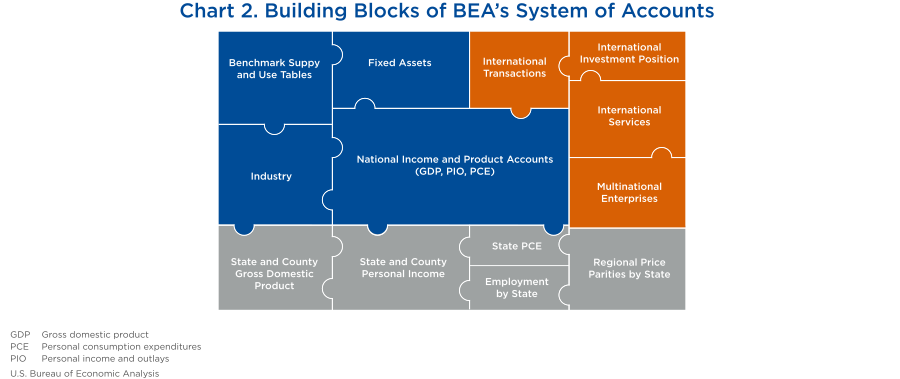
As you might expect, the NEAs have more of a domestic focus. They provide a comprehensive view of U.S. production, consumption, investment, exports and imports, and income and saving. As with the IEAs, there are four major building blocks—the National Income and Product Accounts, the benchmark supply and use tables, our fixed asset tables, and our Industry Economic Accounts. Some of these building blocks provide a wide-lens view of U.S. economic activity, while others zoom in to provide important detail.
Our REAs provide more detail on local economies and tell us about the geographic distribution of U.S. economic activity and growth. The estimates of gross domestic product by state, state and local area personal income, state personal consumption expenditures and employment, and local area regional price parities provide the data for analyzing and comparing individual state and local area economies. While the structure of the REAs often mirrors that of the NEAs, the breadth and depth of the data they provide are unique.
These differences in focus and underlying structure across the IEAs, NEAs, and REAs allow the system of accounts as a whole—the three sets of economic accounts together—to encompass the entirety of the U.S. economy. While each is focused on a different facet of our economy, taken together, they provide comprehensive, integrated, and consistent measurement of U.S. economic activity.
Suggested citation
Vipin Arora, “BEA's Economic Accounts: The Foundation for Today's Most Essential Economic Statistics,” Survey of Current Business (June 17, 2026), https://doi.org/10.66137/CTAR6393.
