

BEA's Economic Accounts, Part 2
Connecting America to the World
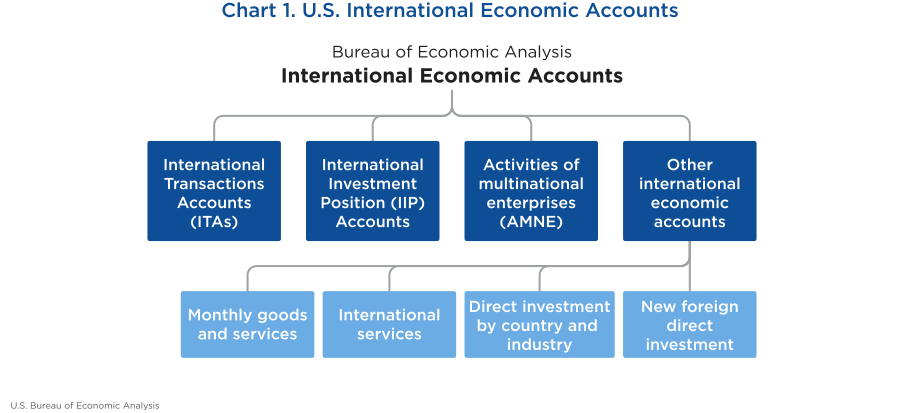
As the United States engages in trillions of dollars of trade and investment with the rest of the world each year, understanding the scale, composition, and direction of those interactions is essential for sound policy, business strategy, and economic research. The U.S. Bureau of Economic Analysis (BEA) International Economic Accounts (IEAs) provide this vital foundation by presenting an integrated and comprehensive view of U.S. engagement with the global economy. The IEAs comprise three integrated core accounts (chart 1): the International Transactions Accounts (ITAs), a statistical summary of transactions between U.S. residents and the rest of the world; the International Investment Position (IIP) Accounts, a statistical summary of the stocks of U.S. financial assets and liabilities vis-à-vis the rest of the world; and the activities of multinational enterprises (AMNE) statistics, which measure the financial and operating activities of U.S. multinational enterprises (MNEs) and the U.S. affiliates of foreign MNEs. In addition to these core accounts, the IEAs include several related statistics, or other international economic accounts, which include monthly trade in goods and services, international services, direct investment by country and industry, and new foreign direct investment in the United States.
The IEAs broadly follow internationally agreed statistical guidelines, which provide a common measurement framework that facilitates consistent analysis and meaningful comparisons with other countries. BEA compiles the IEAs using a wide variety of data sources that are adjusted as needed to meet the definitions and concepts used for the accounts. Much of the source data are collected through BEA surveys, which fall into two broad survey programs that collect data on (1) direct investment and activities of MNEs and (2) trade in services. Other major sources of data are the U.S. Treasury Department's Treasury International Capital (TIC) reporting system and the U.S. Census Bureau.
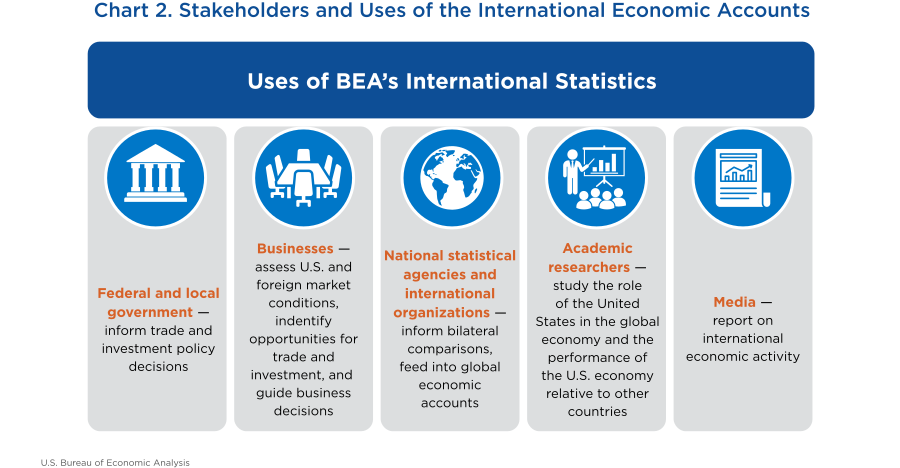
The IEAs are used by a variety of stakeholders to understand the role of the United States in the global economy (chart 2). They help inform federal and local government assessments of international competitiveness and trade and investment policies, while providing businesses with insights to guide decisions about affiliate locations, foreign market conditions, and cross-border opportunities. The IEAs also feed into global statistical databases maintained by international organizations, providing partner-country comparisons that amplify their value. Researchers use them to study the operations of multinational firms, global capital flows, and the evolving U.S. role in international production networks, while the media use them to report on international economic activity and explain how the United States interacts with the broader global economy.
Like BEA's National Economic Accounts (NEAs) and Regional Economic Accounts (REAs), the IEAs are guided by three core principles: comprehensiveness, integration, and consistency. These principles ensure the IEAs deliver relevant, timely, and reliable statistics to characterize the U.S. role in the global economy and the performance of the U.S. economy relative to other countries. This article provides a brief overview of the history behind their development and examines the IEAs through the lens of these guiding principles.
Efforts to measure U.S. economic interactions with the rest of the world date back more than a century. The first official balance of payments estimates were published in 1923 by the U.S. Department of Commerce Bureau of Foreign and Domestic Commerce, with the statistics later extended back to 1919. These early accounts took on new importance during World War II, when policymakers relied on them to track the flow of goods and services abroad. In the post-war period, with the responsibility for producing the accounts in the hands of BEA's predecessor, the Office of Business Economics, the accounts became even more closely watched as a primary tool for measuring the value of financial assistance provided by the United States for reconstruction. Analysis of postwar international investment activity culminated in the publication of the first IIP statistics in 1954.
By the late 1960s, growing currency convertibility and rapidly rising global capital flows exposed the limitations of the existing balance of payments framework, leading to significant debate over how best to present the accounts. BEA's presentation had relied heavily on several “partial” balances that focused on components of the current account and selected long-term capital flows. However, these balances gave an incomplete picture because they excluded financial transactions, which were rapidly increasing in scale and complexity, particularly through U.S. banks' expanding activity in the Eurodollar market. As capital became more mobile, it grew harder to distinguish between transactions in liquid and illiquid assets and to separate market-driven financial flows from official settlement transactions under the fixed-exchange-rate system. At the same time, disagreements emerged over how to construct a single overall balance that accurately captured total payments flows. Several summary balances were published, but they often gave conflicting signals and were too volatile to serve as reliable indicators of longer run developments in the payments position of the United States. These challenges were compounded by limitations in the reporting system and by complexities arising from the dollar's role as an international reserve currency.
Concluding in 1971 that “no single balance can adequately represent the underlying balance of payments position of the United States,” BEA retained and slightly refined its presentation of “a spectrum of balances.” However, the end of the Bretton Woods fixed exchange rate system in 1973 reduced the relevance of these overall balances. In 1976, following the recommendations of an expert panel, BEA substantially updated its balance of payments presentation: overall balances were eliminated, and partial balances were demoted to addenda items. The committee also recommended that BEA's primary presentation feature “international transactions” rather than “balance of payments,” leading to the accounts being renamed the International Transactions Accounts.
The United States began collecting data on U.S. multinational enterprises in the 1920s. The first data release in 1930 was limited to the value of foreign commercial assets controlled by U.S. companies. The Bretton Woods Agreements Act of 1945, which required the United States to share data with the newly formed International Monetary Fund, spurred the introduction of questions on the financing and operations of foreign affiliates in the 1950 census of U.S. direct investment abroad and the 1959 census of U.S. affiliates of foreign MNEs, the earliest precursors of the modern AMNE statistics. The authority to collect these data regularly on a mandatory basis was secured with the enactment of the International Investment Survey Act of 1976.
The 1980s and 1990s brought a significant expansion of the IEAs' coverage of international services trade. The International Investment and Trade in Services Survey Act of 1984 amended the 1976 act to establish mandatory reporting of U.S. international trade in services, enabling BEA to broaden its collection of international trade in business services. Collection of gross, rather than net, trade between affiliated enterprises and new surveys of unaffiliated transactions further broadened coverage. The 1990s were marked by continued expansion, including improved statistics for exports and imports of financial services and the adoption of new international guidelines that established three main accounts for the ITAs—current, capital, and financial—that remain the backbone of the accounts today.
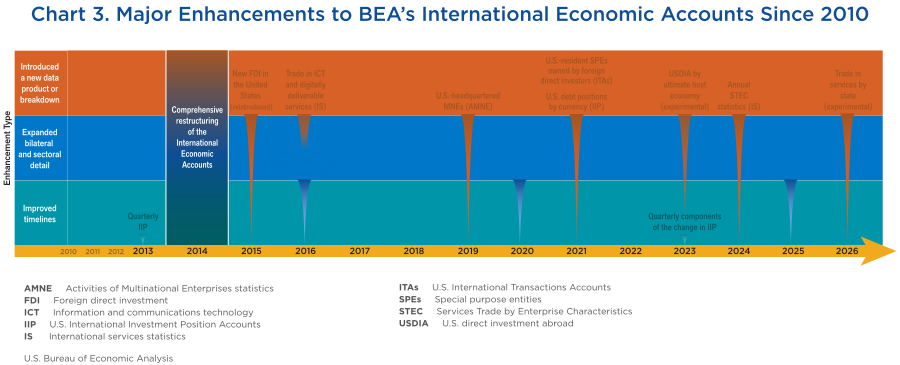
As globalization accelerated in the 2000s and 2010s, BEA updated the presentation and coverage of its international accounts to keep pace (see chart 3 for a timeline of major enhancements to the IEAs since 2010). In 2013, BEA introduced quarterly IIP statistics, improving the timeliness of measures used to assess U.S. vulnerability to external financial shocks, seen as ever more important in the aftermath of the 2008 financial crisis. In 2014, BEA completed the most significant restructuring of the IEAs since 1976, aligning the presentation of the IEAs with updated international guidelines that simplified sign conventions, reorganized the financial account and IIP by functional category, and improved sector detail. In 2015, BEA reintroduced statistics on new foreign direct investment.
More recent innovations have further expanded bilateral and sectoral detail and introduced new data products and breakdowns beyond the core measures. Examples include the introduction of statistics on services trade by enterprise characteristics (STEC) and the expansion of partner-country detail for trade in services to 237 countries and areas. BEA has also released experimental statistics on U.S. direct investment abroad by ultimate host economy and on services trade by state.
BEA continues to innovate methodologically, guided by research priorities focused on better measuring drivers of growth, the impacts of growth, economic linkages, measurement gaps, and ongoing improvements in accuracy and timeliness. These developments reflect BEA's sustained commitment to providing relevant, timely, and reliable statistics.
Like BEA's other economic accounts, the IEAs are guided by three core principles: comprehensiveness, integration, and consistency. Adoption of these principles ensures the IEAs offer a coherent framework for analyzing the U.S. role in the world economy, providing meaningful comparisons over time and across partner countries, while linking international economic activity to the broader national economy.
Comprehensiveness
The IEAs offer a broad and detailed view of U.S. international economic activity. Transactions, positions, financial and operating data, and other statistics complement one another to present a complete picture of the U.S. position in the global economy.
The IEAs include extensive geographic detail by partner economy. Quarterly bilateral detail is published in the ITAs for 35 countries and areas, with greater partner-country granularity for trade in goods, trade in services, and direct investment income, transactions, and positions. Information on over 225 countries and areas is available annually for total services exports and imports, the U.S. direct investment position, and key metrics in the AMNE statistics. This bilateral depth supports comparisons and reconciliation exercises with partner countries. Geographic detail also extends to the subnational level: selected U.S. affiliate AMNE statistics and new foreign direct investment statistics are available by U.S. state.
Beyond geography, the dimensions of classification of statistics featured in BEA's IEAs vary to best fit the nature of each account. BEA's trade statistics present detailed product information, featuring over 100 end-use categories for goods and more than 50 service categories quarterly. Expanded annual detail for services provides more detailed insight for trade in more than 100 categories, in such areas as research and development, information services, and intellectual property rights. Industry detail in BEA's statistics on multinationals is equally rich, providing insights into the global engagement of key sectors of the U.S. economy: several measures of activity in the AMNE statistics and direct investment transactions, income, and positions span more than 250 industries. In addition, trade in services is disaggregated by over 25 industries. Financial assets and liabilities in the ITAs and IIP are organized by five functional categories—direct investment, portfolio investment, other investment, reserve assets, and financial derivatives other than reserves—and then by instrument type.
In addition to the dimensions already discussed, the IEAs offer detail along many other dimensions including by affiliation for trade in services; by U.S. state for new foreign direct investment in the United States; and by maturity, currency, and/or sector for financial assets and liabilities transactions and positions statistics. Detailed insights into selected sectors are also published, such as in direct investment statistics on special purpose entities (SPEs) and statistics on trade in information and communications technology services and digitally deliverable services. The IEAs also include information to support deeper analysis of their core statistics, including information on the characteristics of firms that trade services in its STEC statistics.
The IEAs include monthly, quarterly, and annual statistics, with historical time series that support longer-run analysis. BEA publishes U.S. international trade in goods and services statistics monthly, the ITAs and IIP Accounts quarterly, and AMNE statistics annually. Certain statistics on direct investment by country and industry are released quarterly, others annually. ITA statistics are available starting in 1960, with more detail available starting in 1999. The IIP is available starting in 1977, with more detail available starting in 2005. Comprehensive AMNE financial and operating data are available starting in 1977 for foreign direct investment in the United States and from 1982 for U.S. direct investment abroad.
Integration
The IEAs are integrated across four dimensions: with the NEAs, with the REAs, internally among the IEAs themselves, and with the accounts of partner countries. This multidimensional integration ensures international flows and positions are consistently reflected across all BEA accounts and that U.S. data can be meaningfully compared with and reconciled against those of its trading partners.
Integration with NEAs
Through shared definitions, classifications, and accounting principles rooted in the national accounting framework, the IEAs are closely integrated with the NEAs, which consist of the BEA-produced National Income and Product Accounts (NIPAs) and Industry Economic Accounts as well as the Financial Accounts of the United States (FAUS), prepared by the Federal Reserve Board (FRB). In several cases, IEA statistics serve directly as source data for the NEAs, ensuring that international activity is fully and consistently reflected in the domestic accounts.
The NIPAs present the value and composition of domestic output and the distribution of incomes generated in production. Exports and imports of goods and services from the ITAs feed directly into the estimate of net exports used in the expenditure-based calculation of gross domestic product (GDP). Income flows to and from foreign residents represent the international dimension of series such as national income and corporate profits. ITA balances also align with the NIPA concepts of net lending and net borrowing and the difference between gross savings and gross domestic investment.1
The Industry Economic Accounts, comprising the Input-Output (I-O) Accounts and GDP by industry statistics, rely on the ITAs to measure the international dimension of output at both the national and industry levels. Import use tables derived from the I-O Accounts, which show the use of imported goods and services by industries and final uses, draw, in part, on ITA data.
The FAUS record the acquisition and sales of nonfinancial and financial assets throughout the U.S. economy, the sources of funds used to acquire those assets, and the value of assets held and of liabilities owed. Data on transactions and positions in financial assets and liabilities from the ITAs and IIP Accounts provide the international component of these accounts. BEA and the FRB jointly publish the U.S. Integrated Macroeconomic Accounts, which draw on the NIPAs, the ITAs, and the FAUS to reconcile flow and stock measures at the national level.
Integration with REAs
The connection between the IEAs and the REAs operates primarily through each set of accounts' shared links to the NEAs: the REAs provide a geographic decomposition of national measures that themselves incorporate international components from the IEAs. There are also direct connections. The estimation of state personal income draws on compensation measures from the ITAs to construct residence adjustments that accurately capture income earned by U.S. residents working in border regions or employed at foreign embassies, consulates, and international organizations located in the United States. State-level personal consumption expenditures (PCE) similarly draw on the methodology underlying the ITAs' estimates of international travel to allocate net foreign travel expenditures across states. This PCE category refines the coverage of PCE to include expenditures on foreign travel by U.S. residents and exclude expenditures on travel to the United States by nonresidents.
Integration within IEAs
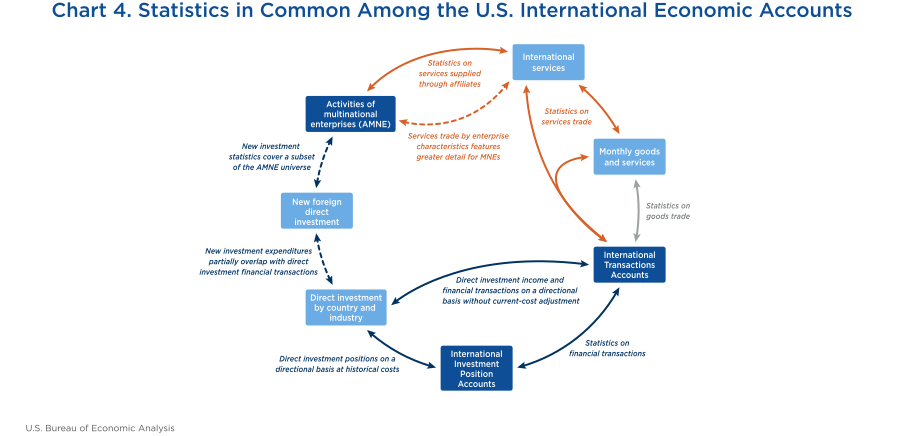
Within the IEAs, shared data inputs and estimation methods create many links across the core and other accounts (chart 4). The financial account transactions in the ITAs flow into the positions recorded in the IIP. The AMNE statistics provide information on the finances and operations of multinational enterprises reflected in the direct investment transactions and positions in the ITAs and IIP. Other accounts complement the core accounts by providing various dimensions of detail. Monthly goods and services statistics supply a higher-frequency view of the trade flows in the ITAs. Direct investment by country and industry statistics present a cross-tabulation of the direct investment income and financial transactions in the ITAs and positions in the IIP Accounts. International services statistics extend the trade-in-services data in the ITAs by service type and partner country and introduce detail on affiliation of trading parties; deepen the AMNE statistics' coverage of services supplied through the mode of direct investment in the services supplied through affiliates statistics; and, through the STEC statistics, characterize the firms engaged in services trade in terms of industry, firm ownership type, and employment size class, for example. Statistics on new foreign direct investment provide a focused view of expenditures to acquire, establish, or expand a U.S. business by a subset of the U.S. affiliates reflected in the AMNE statistics.
Symmetry with partner countries
A fourth dimension of integration links the IEAs to the accounts of partner countries. The IEAs are closely aligned with internationally agreed guidelines that are based on a double-entry accounting system with established definitions, classifications, time of recording, and valuation principles. The main characteristic of double-entry accounting is that each transaction generates two corresponding entries in the accounts of the transactors: a credit and a debit. When both countries in a transaction follow these same guidelines, the result is a quadruple-entry structure that, in principle, makes each country's recording of the transaction a mirror image of the other's. This symmetry of partner-country statistics provides policymakers, researchers, and others with a strong statistical foundation for understanding and responding to international economic events, such as the 2008 financial crisis or the COVID–19 pandemic.
In practice, asymmetries arise due to a variety of factors, including differences in data sources, methods, timing, valuation, classification, and coverage across countries. BEA analyzes bilateral asymmetries and engages in reconciliation exercises with partner countries to understand and reduce such discrepancies.
The IEAs' alignment with the integrated framework established in international statistical guidelines and the use of common data sources and methods ensures consistency across all measures of U.S. international economic activity. They draw on common source data, including from BEA surveys, the TIC system, the U.S. Census Bureau, and other sources. Data sources are evaluated and cross-checked to ensure consistency and reliability. The IEAs also employ transparent and standardized industry and product classification systems and geographic definitions. This methodological uniformity ensures that measures are comparable across accounts.
The IEAs also maintain temporal consistency when possible. Updates to incorporate newly available data, method changes, or new definitions or classifications are routinely carried back through time. This practice preserves the continuity of historical series and allows users to trace long-run trends in U.S. international economic activity. BEA's ongoing research and innovation agenda sustains its commitment to consistency, ensuring methods remain relevant as economic activity evolves, while preserving trends in the data series.
BEA's IEAs form a coherent measurement system that captures the full range of international economic engagements that connect the United States to its international partners. Built on the principles of comprehensiveness, integration, and consistency, the IEAs provide timely indicators, detailed bilateral perspectives, and an integrated view of how international trade, investment, and financial flows shape the national economy. As international economic relationships grow more complex, the IEAs provide an indispensable resource for understanding the U.S. role in the global economy.
BEA has continuously modernized the IEAs to keep pace with an evolving global economy and the needs of a wide range of users. Methodological advances, expanded coverage, increased detail, and accelerated release schedules have made these accounts more relevant and accessible than ever. Policymakers rely on the IEAs to assess the U.S. international economic position and evaluate the effects of trade and investment policies. Businesses draw on them to identify opportunities in foreign markets and make informed decisions about international operations. Researchers use them to examine the activities of multinational enterprises, the dynamics of global capital flows, and the shifting U.S. role in the world economy. By providing timely, accurate, and relevant economic statistics that connect the United States to the rest of the world, the IEAs provide a foundation for informed decision-making.
- While concepts and sources are largely harmonized, small adjustments are made to the ITA statistics before they are incorporated into the NIPAs. The largest adjustments to GDP are to exclude transactions for U.S. territories, which are treated as part of the United States in the ITAs but included in the rest of the world for the NIPAs, and to exclude certain nonmonetary gold transactions recorded in the ITAs that are not for business or industrial use. Adjustments are also made to account for differences in revision cycles and to remove certain military grant transfers recorded in the ITAs services exports and in the NIPAs as federal government defense expenditures. See NIPA table 4.3C and NIPA Handbook: Concepts and Methods of the U.S. National Income and Product Accounts, chapter 8, for more information.
Suggested citation
Alexis Grimm, “BEA's Economic Accounts: Connecting America to the World,” Survey of Current Business (July 22, 2026), https://doi.org/10.66137/GNGT9446.
