

Updated Experimental Ultimate Host Economy Statistics
A recent U.S. Bureau of Economic Analysis (BEA) working paper updates BEA's work on producing ultimate host economy (UHE) statistics for U.S. direct investment abroad (USDIA). Existing BEA statistics record USDIA by immediate partner economy—the country of the first non-U.S. entity in an ownership chain. Though well suited for many purposes, this approach can mask the ultimate destination of investment because many affiliates of U.S. multinational enterprises are holding companies or other special-purpose entities that exist mainly to route funds elsewhere. BEA's research into UHE statistics examines a series of techniques that reallocate the USDIA equity position by immediate host economy, thereby providing a clearer picture of the economies that are the ultimate targets of USDIA.
The paper, authored by Kirsten Brew, Amanda Budny, Jessica Hanson, Ryan Smith, Larkin Terrie, and Dan Yorgason, builds on a 2023 BEA working paper and introduces three main methodological updates. First, it modifies three previously considered reallocation methods (first operating affiliate, passthrough with ownership chains, and U.S. parent's equity share in affiliates' assets) to address conceptual or implementation issues and to make better use of available data. Second, it adds three new methods to the set of candidate reallocation approaches: passthrough minimum (a variant of the passthrough with ownership chains approach), operating assets apportionment, and composite index apportionment. The latter two methods improve on the apportionment approach presented in the 2023 paper by using detailed company-level microdata (including ownership chains) to apportion equity according to measures of operating activity, rather than relying only on country-level aggregates. Third, the paper expands ownership chains to include U.S.-based affiliates by using BEA's surveys of foreign direct investment in the United States; this change allows the reallocation logic to route investment back into the United States where appropriate or to capture passthrough investment that moves through U.S. affiliates before returning abroad.
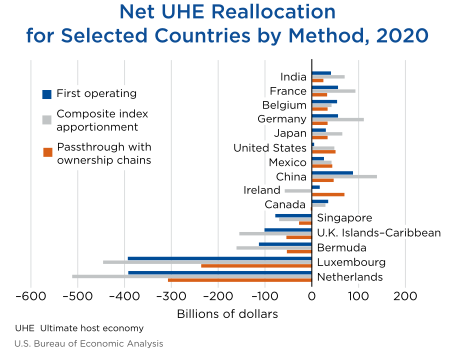
Empirical work uses BEA direct investment survey data for 2019 and 2020 to compare six of the reallocation methods in detail, evaluating each along several dimensions, including conceptual accuracy, ease of implementation, reliance on microdata, robustness to inconsistent data, degree to which the method reallocates USDIA (liberal versus conservative), and alignment with international statistical guidelines. Based on this analysis, three methods (first operating affiliate, passthrough with ownership chains, and composite index apportionment) are identified as meriting further exploration. Detailed country and sector results are presented for these three methods. These results are based on data that incorporate EZS noise infusion, an approach to the protection of survey-respondent confidentiality that has not previously been used in BEA research and that allows for the presentation of more detailed results than would otherwise be possible.
Results show common patterns across the three preferred methods. All three produce large net reductions in the USDIA equity position in known intermediary jurisdictions: chiefly the Netherlands, Luxembourg, Bermuda, U.K. Islands–Caribbean, and Singapore. The methods also produce similar industry-level shifts, notably large net reductions in the USDIA equity position in holding companies. However, important differences appear: composite index apportionment reallocates larger amounts of equity across countries than the other two methods, and it shifts industry shares differently—producing smaller net increases for finance and insurance and larger net increases for manufacturing than the other preferred methods.
The paper concludes that the three favored methods merit continued development and testing. It documents methodological choices and tradeoffs, demonstrates practical implementation using recent BEA microdata, and highlights how incorporating U.S. affiliates and richer firm-level measures of operating activity can enhance UHE reallocation. Through these enhancements, this work aims to produce statistics that better reflect where U.S. direct investment genuinely supports productive activity, while also addressing disclosure and data quality challenges inherent in such reallocations.
