

Early Estimates of AI’s Economic Impact
Has the burgeoning influence of artificial intelligence (AI) translated into measured macroeconomic statistics? If so, where and how would we expect to see those impacts, and what are the current challenges in identifying and measuring those impacts? If not, is it because the statistics are lacking? And if they are, is a paradigm shift in economic statistics required to capture these new technologies, or is a narrow focus on particular areas and data collection sufficient? A recent U.S. Bureau of Economic Analysis (BEA) working paper by Tina Highfill and Jon D. Samuels addresses these questions.
The paper examines the economic impact of AI in the United States, focusing on the challenges of measuring AI's effects using current national economic accounts. Since there is currently no direct line item for AI in the U.S. accounts, the authors use indirect methods, analyzing data from the BEA industry accounts. They discuss measurement difficulties and recommend steps for future research and data collection.
The inquiry draws on the experience of measuring information technology (IT) in the late 20th century, when economists debated the IT productivity paradox—the notion that IT’s rapid advances were not immediately visible in economic statistics. Over time, with better data and new techniques, researchers showed that IT production and investment were major contributors to U.S. economic growth.
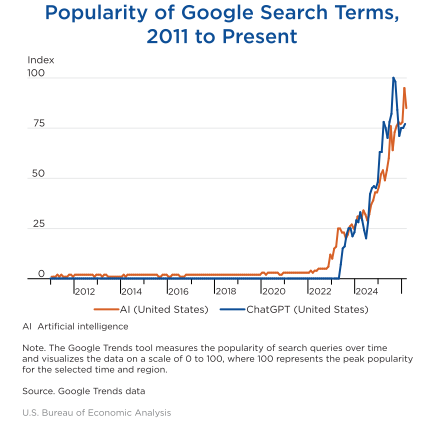
The U.S. statistical system has started to address the need to measure AI's economic effects. For example, the U.S. Census Bureau and the National Center for Science and Engineering Statistics began collecting data on AI use by industry in the 2019 Annual Business Survey, with some data available for 2016–2018. Based on mentions in Google Trends data, as depicted in the chart, AI seems to have entered the zeitgeist in 2022. Therefore, the Highfill-Samuels paper takes that as a starting point for when AI may have begun to have macroeconomic impacts.
The paper does not claim to answer all questions about AI’s economic effects. Instead, it assesses what can be learned from currently available macroeconomic data, draws early conclusions, and makes recommendations for next steps. The focus is on broad, economy-wide impacts, rather than the microeconomic effects of AI that might be visible at the firm or industry level before showing up in national statistics.
Using a difference-in-difference model applied to BEA’s data, the authors find that, in their baseline model, AI is associated with higher productivity and reduced use of inputs, including labor. They also find that AI is linked to a shift in the workforce toward younger, less educated workers. An alternative model, using different assumptions about when AI became widespread, produces less robust results but still suggests that AI is labor saving.
The authors emphasize that these findings are preliminary and are sensitive to the choice of model and data. They note that measuring the macroeconomic impact of AI is different from measuring earlier technologies like IT, partly because adopting AI does not always require large capital investments. They recommend further research, with an emphasis on more detailed and consistent data collection, more direct measures of AI use, and improved methods to better understand how AI interacts with other inputs in production.
