

Reclassifying Own-Account Data as a Capital Asset
In its 2025 revision, the System of National Accounts now recommends treating own-account data and databases as intangible capital assets, and two recent U.S. Bureau of Economic Analysis (BEA) working papers present efforts to implement that recommendation for the United States and to estimate the results.
The first paper, by José Bayoán Santiago Calderón, develops proposed methodology and experimental estimates for 1997 to 2024. The second paper, in which Santiago Calderón is joined by Jon D. Samuels and Corby Garner, uses those estimates to modify the Integrated Industry-Level Production Account and assess effects on sources of productivity growth from 2002 to 2024.
At the core is a change in economic accounting: spending on own-account data is treated as investment rather than expense. In this framework, own-account data and databases are data resources that organizations generate and curate for their own use, with expected sustained future revenue streams and ongoing production benefits. The papers emphasize that this treatment resolves an inconsistency in capital formation, where databases developed for sale or license were already treated differently from databases developed for own use. Capitalization therefore expands the production boundary and recognizes data-intensive production more explicitly in gross fixed capital formation (GFCF), consumption of fixed capital, net stock, value added, and capital services.
The first paper details annual industry-level nominal values, prices, and volume estimates for GFCF, consumption of fixed capital, and net stock for the new asset class. It positions this work as experimental economic statistics intended to preview implementation, gather feedback, and prepare for the international target window for national statistical offices. The methodology builds on prior BEA capitalization transitions for software and research and development, and on recent international collaboration. It also incorporates methodological refinements relative to earlier work: adjusting the production boundary to exclude data use activities such as analysis, refining multiple-counting adjustments, harmonizing definitions with international standards, including government investment, extending time coverage, and treating self-employment more explicitly. The paper highlights ongoing discussions around asset-boundary choices, occupation involvement rates, pseudo-output prices, and depreciation profiles and points to reproducibility materials and posted tables to support transparency.
The second paper takes these measurement updates into productivity analysis. It examines both the output and input sides of the integrated production accounts. On the output side, the accounts capture newly recognized GFCF in data and databases; in real terms, this is new real value added. On the input side, data provides a capital service flow to industries that use it. Within growth accounting, total factor productivity is the difference between real output growth and real input growth after including production and use of own-account data and databases. This setup allows updated contributions of capital and labor across industries and a clearer decomposition of growth.
Across the period studied, both papers point to faster measured growth when data and databases are capitalized. The first reports that the economy grew at an average rate about 7 basis points faster from 2002 to 2024, with the increase attributed mainly to more rapid capital growth, especially intangibles and information and communication technology, and to slightly lower measured productivity growth in the aggregate. The second paper further finds that including own-account data raises the contribution of information technology-related capital assets to gross domestic product growth by about one-third, while effects differ significantly across industries.
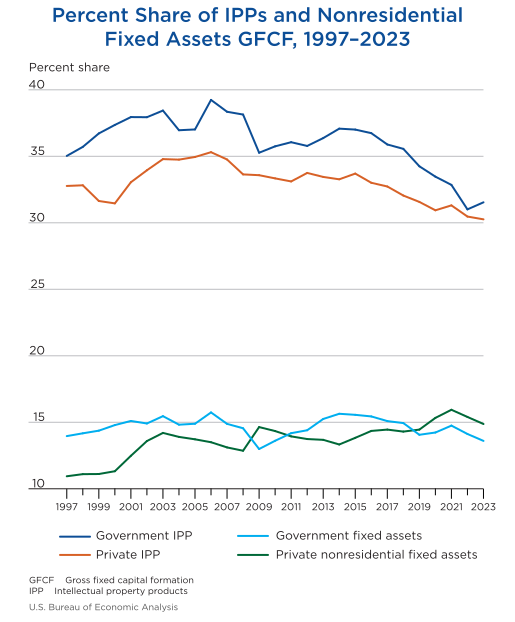
A shared conclusion is that capitalization reallocates part of what had appeared as productivity gains into measured capital accumulation. Aggregate total factor productivity is slightly lower after inclusion—because, while output grows faster as the asset being produced is now part of output, the change is not big enough to offset the growth in capital—yet industry-level impacts are heterogeneous. Service industries that rely more on labor can experience productivity gains when newly recognized data output grows faster than newly recognized combined inputs. The chart shows the updated composition of annual investment in intellectual property products (IPPs), private nonresidential fixed assets, and government IPPs and fixed assets when recognizing own-account data and database assets.
Overall, the combined evidence indicates that treating own-account data and databases as assets rebalances capital composition toward IPPs and digital technologies, raises measured value added and growth, and improves the economic accounting of how modern businesses produce, use, and benefit from data.
