Expanded Indicators in U.S. Household Production Statistics
Household production economic statistics measure the value of unpaid work in the home, such as cooking, cleaning, and taking care of the kids. This unpaid work is not included in the calculation of U.S. gross domestic product (GDP), but tracking its value provides important insights, and a recent U.S. Bureau of Economic Analysis (BEA) working paper by Benjamin R. Bridgman presents a significant expansion of indicators in these statistics.
BEA has tracked household production for nearly 30 years in a supplementary economic account, but these statistics have only included estimates of aggregate value added. Such data are useful for tracking the overall size of household production over time, and they have the added advantage that they can be calculated separately from market GDP with relatively limited source data requirements. However, many applications require more detailed information about household production. For example, policymakers evaluating actions to support the provision of elder care will be interested in knowing the value of that care provided by families outside measured GDP. Such analysis requires breaking up household production into component services and providing detail on the input mix used to produce them.
With these needs in mind, the changes detailed in the Bridgman paper increase component service-level detail, add expenditure and gross output measures, and align household production with comparable market industries. For the first time, the household production economic statistics report:
- Expenditure on household production.
- Both value added and expenditure for component household production services.
- Extended use tables that incorporate household production indicators.
This expansion of the accounts not only greatly expands the detail that the accounts provide but also integrates household production into the input-output structure of the economy. It makes the household production accounts much more similar to their market equivalent. The accounts include an expenditure concept that has been absent from BEA’s previous accounts. The expenditure concept is useful for many applications, since it gives a clear interpretation when evaluating theories that center on household demand.
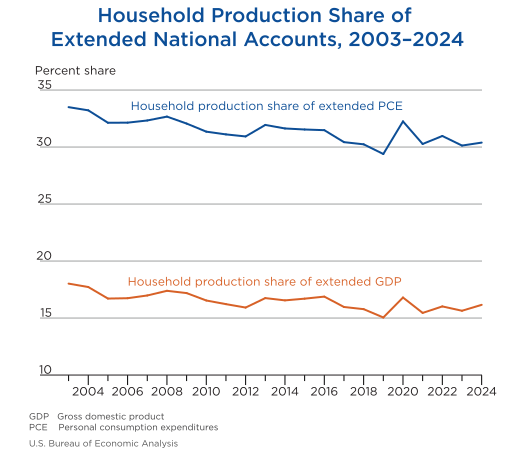
The analysis includes a look at the overall size of household production relative to the market economy, comparing the household production share of extended personal consumption expenditures (PCE) with the household production share of GDP. Household production is a major source of consumption, accounting for roughly a third of extended PCE. As shown in the chart, this is about twice the contribution of household production value added to extended GDP: household production value added was 16 percent of extended GDP in 2024, while that of extended PCE was 30 percent. Household production is more important to consumption than GDP because the household only produces consumption services, while GDP includes consumption goods, investment, and government services.