

Toward a Unified Definition of Seasonality
Seasonality is a familiar statistical concept with a long history of research and development at national statistical agencies such as the U.S. Bureau of Economic Analysis (BEA), U.S. Census Bureau, and U.S. Bureau of Labor Statistics. However, there are more than a dozen differing definitions of seasonality found throughout the economics and statistics literature. In a recent BEA working paper, Carter Bryson and Gary Cornwall carefully lay out a new definition of, test for, and adjustment of seasonality that is transparent, statistically robust, and scalable. Their research aims to build consensus around a more unified approach to seasonal identification and adjustment, which will allow data providers to improve resource allocation, data quality, and communication.
Their paper begins by distilling the many competing definitions into a single foundational one, stated in both plain language and mathematical terms. In plain terms: a series is seasonal if, among all its possible repeating cycles, the ones associated with chosen cycles of interest are demonstrably larger than the others. In other words, their definition involves comparing the magnitude of those chosen cycles with others, forming a measure of relative signal strength. The mathematical version is precise and can be directly measured from the data, and from it, a test and adjustment method directly follow.
This single design choice delivers the qualities statistical offices in a modern, high-volume data environment most need. Because detection and adjustment both stem from the stated definition, each step is transparent, replicable, and explainable to policymakers and the general public. Seasonal adjustment becomes a well-posed statistical problem with a clearly stated target. Finally, because the adjustment reduces to a single, well-defined operation that leans on few assumptions, it can be applied broadly and consistently across many series without manual intervention.
The authors observe that the central difficulty in seasonal adjustment is conceptual rather than computational. In the absence of a unified definition of seasonality, diagnostics and adjustment procedures cannot be coherently aligned, resulting in heterogeneous treatment across producers and making clear communication between data providers and users difficult. They address this gap by introducing a nontautological, frequency-domain definition based on relative peak dominance that yields a well-defined population object.
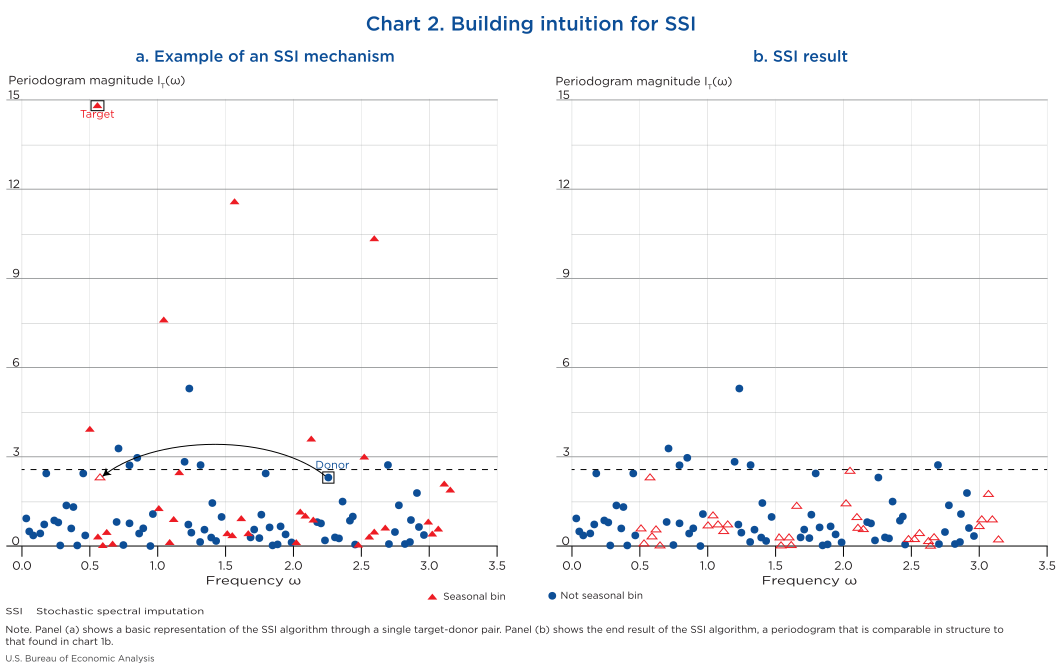
From this object, they derive a test statistic with a known and analytically tractable null distribution and an adjustment operator—stochastic spectral imputation (SSI)—that follows directly from the same logical construct. The result is an internally consistent structure in which definition, detection, and adjustment are mutually reinforcing rather than loosely connected.
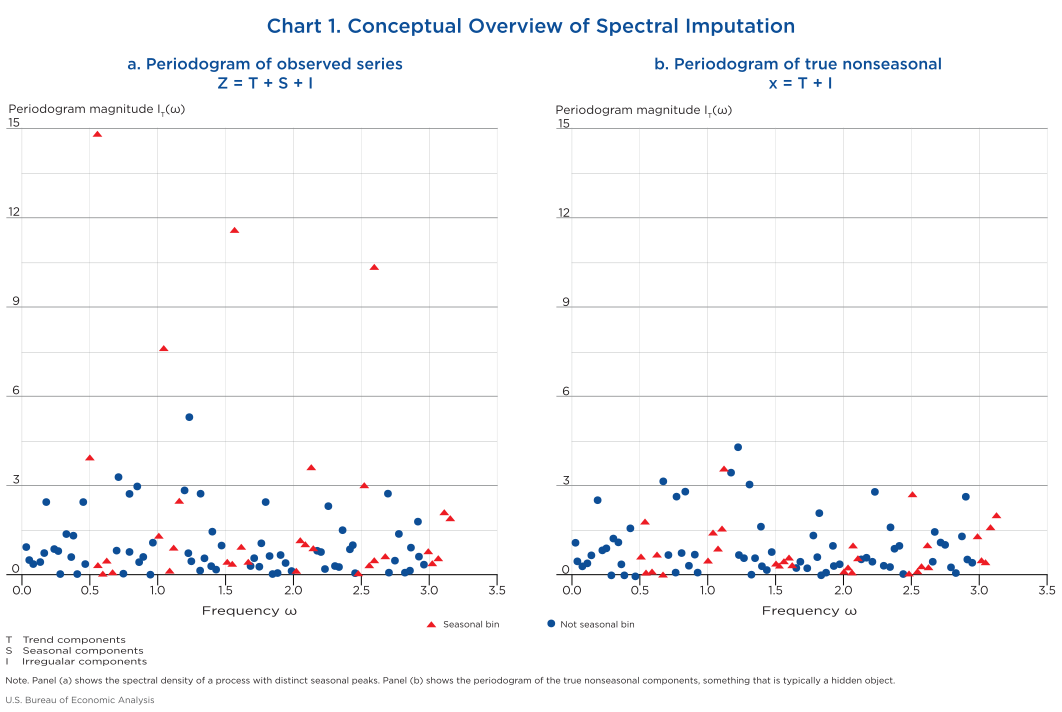
Charts 1 and 2 illustrate the concept of SSI, supposing the generation of a series that is an additive function of trend (T), seasonal (S), and irregular (I) components: Z = T + S + I. The paper includes a detailed explanation of this process.
[View larger chart]
[View larger chart]
