

Examining Quarterly Measures of Labor in the U.S. Economy
Researchers at the U.S. Bureau of Economic Analysis (BEA) are building prototype quarterly measures to examine industry-level labor input and composition. BEA researchers David Jang and Jon D. Samuels explain these new measures in two recent working papers.
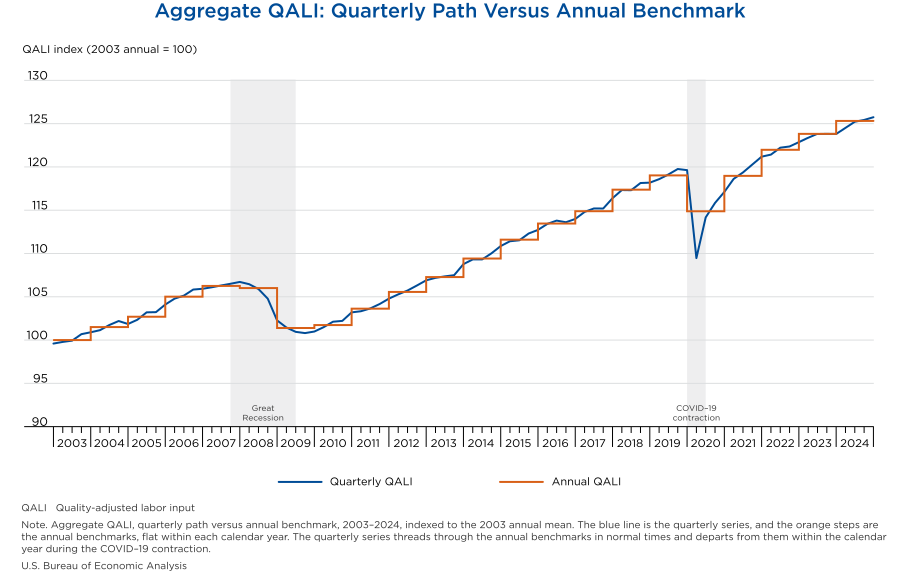
Industry-level labor input is conventionally measured annually. This annual measurement averages away peaks, troughs, and early recoveries into a single value, while the prototype quarterly measures bring greater clarity to short, concentrated shocks like the COVID–19 contraction. Additionally, there is growing demand across the U.S. statistical system for higher-frequency industry-level data beyond the current official data on U.S. productivity growth, which has been available at annual and aggregate quarterly frequencies for many years. This new industry-level data would aid in evaluating rapidly evolving economic conditions.
The first paper by Jang and Samuels makes three main contributions in extending BEA’s annual Industry-Level Production Account labor input framework to the quarterly frequency while preserving its detailed worker-type-by-industry structure. First, the authors use innovative techniques to address small sample sizes for the cross-classification of workers, their hours, and their labor compensation.
Second, they examine the Great Recession, which contracted over six quarters spanning nearly three calendar years, and COVID–19, where the contraction was concentrated in two quarters within 2020, as case studies to demonstrate that the direction of the quarterly-annual measurement gap depends on the shape of the within-year path. Because the COVID–19 contraction and early recovery occurred within a single calendar year, the quarterly peak-to-trough measures are substantially larger than their annual counterparts. In contrast, annual data closely track the slow, multiyear progression of the Great Recession.
Third, the authors characterize labor composition over the business cycle. They find COVID–19’s composition shocks were large, highly concentrated, and broadly transitory. The Great Recession’s shifts, by contrast, were broader and persistent.
The resulting quarterly series demonstrates why frequency matters. Because annual data mechanically absorb the rebounds that follow rapid troughs, they truncate our view of short-duration shocks.
[View larger chart]
The second paper examines the dataset developed by the first paper through the lens of labor composition, introducing a prototype quarterly dataset designed to illuminate the industry-level origins of labor productivity growth.
Using this new dataset, the authors find (1) at the quarterly frequency since 2005, labor composition growth accounted for about 14 percent of aggregate labor productivity growth; (2) small aggregate contributions of labor quality mask industry-level heterogeneity; and (3) at the higher frequency, results indicate labor composition had important momentum at the end of 2024 that explains all of the late-period aggregate labor productivity acceleration. This last finding suggests measuring industry-level labor quality could add useful information to analysis of the business cycle.
