Liquidity Effects From the Tax Cuts and Jobs Act
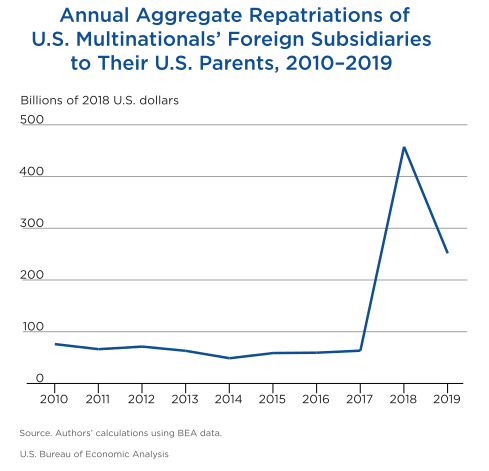
The Tax Cuts and Jobs Act (TCJA) unlocked as much as $1.7 trillion of U.S. multinationals’ foreign cash after going into effect on January 1, 2018. A research paper, using data from the U.S. Bureau of Economic Analysis (BEA) and published in the Journal of Financial Economics, examines the real and financial response to this liquidity shock and finds firms did not increase capital expenditures, employment, research and development (R&D), or mergers and acquisitions (M&A), regardless of financial constraints.
The TCJA changed several features of the corporate tax code. Among its key provisions was unlocking “trapped cash” U.S. multinationals had accumulated in their foreign subsidiaries. Prior to the TCJA, the U.S. corporate tax code incentivized multinationals to defer repatriation of foreign income, leading to large balances of accumulated cash and financial securities. With the changes imposed by the TCJA, firms suddenly had access to additional internal capital at zero marginal cost—funds that previously had been extremely costly to use for U.S. investment or payouts.
The paper, authored by James F. Albertus of Carnegie Mellon University, working in his capacity as a special sworn research consultant to BEA, along with Brent Glover of Carnegie Mellon and Oliver Levine of the University of Wisconsin–Madison, evaluates how this sudden and significant increase in internal liquidity affected real and financial decisions of U.S. multinationals. Although the tax law applied to all U.S. corporations, firms had varying exposure to this policy change based on their accumulated stock of liquid foreign profits. The paper uses confidential data on cash and marketable security holdings at foreign subsidiaries of U.S. multinationals collected by BEA to measure each firm’s exposure to the TCJA-induced liquidity shock. The authors estimate firms’ investment, labor, and M&A decisions in response to this liquidity increase using a difference-in-differences research design. In addition, they explore how firms adjusted their payouts, cash holdings, and leverage in response to the decreased cost of accessing their foreign cash holdings. The results provide insight into how liquidity relates to firm decisions and whether the TCJA was successful in stimulating U.S. investment and hiring by unlocking firms’ foreign cash. On the financial side, the results reveal firms paid out only about one-third of the new liquidity to shareholders and retained half as cash.
The authors find no evidence firms responded to the liquidity shock by increasing investment in the United States: the increased liquidity led to no change in capital expenditure, wage expense, or R&D. Similarly, they find no effect on foreign real activity. Theory predicts real investment should increase if the firm is financially constrained or faces agency conflicts. However, the study does not find the most constrained firms responded differently than the least constrained. Similarly, the response does not vary with the strength of governance. Overall, the results indicate a lack of liquidity did not constrain the real decisions of firms, and unlocking trapped cash likely did not stimulate investment and hiring as proponents of the policy had predicted.