

Integrated BEA-BLS Industry-Level Production Account, 1997–2024
The Sources of U.S. Economic Growth During the Expansion of AI
In April 2026, the Integrated Industry-Level Production Account (ILPA) for the United States was updated to include new statistics for 2024 and revised statistics for 1997–2023. In this short article, the dataset is used to describe the sources of U.S. economic growth from the bottom up across industries over the 1997–2024 period and explore how artificial intelligence (AI)-related industries performed during the onset of the ongoing expansion of AI in the U.S. economy.
The ILPA represents an ongoing collaboration between the National Economic Accounts of the U.S. Bureau of Economic Analysis (BEA) and the Productivity Program of the U.S. Bureau of Labor Statistics (BLS). The account combines industry-level output and intermediate inputs from BEA's Gross Domestic Product (GDP) by Industry Accounts, with capital input and labor data from the BLS Productivity Program, to create an internally consistent production account. It contains detailed data on output and inputs in current and constant prices as well as total factor productivity (TFP) growth by industry.2 The foundations of this account are discussed in detail by Fleck et al. (2014), with expanded discussion of sources and methods in Garner et al. (2018, 2020). A main motivation for the account is it not only presents measures that show which industries expanded or contracted, but it contains information on the changes in the industry-specific production processes that drove these developments.
With this update to the statistics, the underlying data for gross output, intermediate inputs, and value added are now consistent with the results of the 2025 annual update of the Industry Economic Accounts, released on September 25, 2025.3 Data on capital and labor inputs have been updated to reflect the TFP estimates released by BLS in March of 2026.4 The first year of data in the ILPA is now 1997 (in most earlier vintages, it was 1987). This more limited time series reflects fewer years of historical data available in BEA's GDP by Industry Accounts after the release of the comprehensive update in September 2023.
An important feature of the ILPA is it presents an internally consistent accounting of the sources of economic growth. This approach, which originated with Jorgenson and Griliches (1967) at the aggregate level and was expanded to the industry level by Jorgenson, Gollop, and Fraumeni (1987), is important because it separately accounts for changes in the composition of inputs used in production across industries and changes in TFP. The early studies using these methods were focused on analyzing the long-term sources of economic growth by attributing changes in real output growth to the contributions of changes in inputs and TFP, the so-called sources of growth, but more recent studies have used these accounts for studying medium-term (and sometimes short-term) fluctuations in the economy. For example, Jorgenson, Ho, and Stiroh (2005) identify subsample periods to analyze medium-term trends, including the information technology (IT) boom in the mid-1990s, and Garner et al. (2022) examine the Great Recession and the COVID–19 recession. In this article, the updated ILPA is employed to compare the period in the dataset that includes the onset of broad interest in using AI to the preceding period.
The remainder of this article is divided into two main sections. The first section presents results for the entire period covered by the account, 1997–2024, including descriptive statistics on the industry origins of the sources of economic growth. The second part presents results that focus on comparing the economy and the sources of economic growth as AI gained momentum to the preceding period.
Table 1 presents measures of the aggregate sources of U.S. economic growth between 1997 and 2024.5 Within this account, aggregate real value-added growth is attributed via a growth accounting exercise to contributions from the growth of labor input, capital input, and TFP. A robust finding in the many updates of similar tabulations since the seminal work of Jorgenson and Griliches (1967) is that growth rate of capital input accounts for the largest share of U.S. economic growth over the long term. Jorgenson, Ho, and Stiroh (2005) referred to the result that input accumulation, especially capital input accumulation, accounted for the preponderance of U.S. economic growth as “Solow's Surprise” because it overturned the common thinking at the time (based in part on Solow's work) that technological change (measured as TFP) accounted for most of U.S. GDP growth. Understanding the mechanisms for economic growth has important implications for policymakers because misattributing the sources of growth obscures the relationship between policy choices and economic outcomes.
| Component | 1997–2024 | 1997–2021 | 2021–2024 |
|---|---|---|---|
| Value added | 2.33 | 2.28 | 2.68 |
| Capital | 1.10 | 1.12 | 0.95 |
| IT capital | 0.22 | 0.24 | 0.10 |
| Communications equipment | 0.10 | 0.10 | 0.06 |
| Computer hardware | 0.12 | 0.13 | 0.04 |
| R&D capital | 0.13 | 0.12 | 0.24 |
| Software capital | 0.20 | 0.19 | 0.29 |
| Entertainment originals capital | 0.02 | 0.02 | 0.00 |
| Other capital | 0.52 | 0.55 | 0.31 |
| Instruments and other office equipment | 0.03 | 0.03 | 0.02 |
| Other equipment | 0.09 | 0.10 | 0.04 |
| Structures, land, and inventories | 0.35 | 0.36 | 0.26 |
| Transportation equipment | 0.06 | 0.07 | −0.01 |
| Labor | 0.58 | 0.51 | 1.13 |
| College labor | 0.59 | 0.57 | 0.78 |
| Noncollege labor | −0.01 | −0.06 | 0.35 |
| Integrated TFP growth | 0.65 | 0.66 | 0.60 |
- IT
- Information technology
- R&D
- Research and development
- TFP
- Total factor productivity
Notes. Average annual percentage growth. A contribution is a share-weighted growth rate.
U.S. Bureau of Economic Analysis
Based on the current release of the ILPA, increases in capital in the U.S. economy accounted for the largest share of aggregate real value-added growth between 1997 and 2024, followed by growth in TFP, and then the growth of labor. Capital accumulation accounted for almost half of all U.S. economic growth, and TFP growth and labor input each contributed about a quarter.
An advantage of the ILPA is it permits a drill down within both the aggregate and industry-level sources of growth. Within the aggregate capital contribution, the categories that are published within the ILPA include nine different types of capital assets.6 At the aggregate level, the largest capital contributor to the aggregate capital contribution was structures, land, and inventory accumulation. On the one hand, this is not surprising, because the other components of capital are much narrower than this broad category, but on the other, the accounting for these assets emphasizes the ongoing importance of these basic capital assets to long-term U.S. economic growth. The importance of the information technology economy, which accelerated in the mid 1990s, is evident in the significant contributions of IT capital and software over the 1997–2024 period. Importantly, the contributions included in table 1 capture how capital was used as an input on an ongoing basis. That is, the measures capture the entire accumulated past stock of capital investments that are used in production, rather than just the investment in new assets that appears on the expenditure side of the GDP account.
In the aggregate, there are two primary factors of production, capital and labor, that are the inputs into the production process and provide the drivers of economic growth.7 In total, the contribution of capital input accounted for almost half of U.S. economic growth over this period, emphasizing the ongoing importance of investment to the U.S. economy. The ILPA presents two categories of labor input: workers with a bachelor's degree and above (labeled as college workers) and other workers.8 Over the period as a whole, the contribution of workers without a college degree was negative.9 This does not mean each worker without a college degree was a drag on U.S. economic growth; rather, total hours worked by this group declined, so their labor input did not contribute to the increase in aggregate real value added. The quality adjusted labor input for workers without a bachelor's degree also fell, and as a result their measured contribution to growth was negative. In effect, all labor input driven growth during this period came from workers with a college degree. In total, growth in labor input accounted for about one-quarter of aggregate economic growth. For the period the ILPA covers, TFP growth accounted for about the same proportion of aggregate growth as labor input. From an accounting perspective, this indicates that after the growth of capital and labor input is accounted for, about a quarter of U.S. economic growth was driven by TFP growth. From an economic perspective, under neoclassical assumptions, this indicates that improvements in production processes, quality change in outputs, and efficiency improvements were important drivers of economic growth, but not as important as the growth in inputs used in production.
The main purpose of the industry-level account is to illuminate the industry origins of these aggregate trends. Table 2 gives the industry contribution to aggregate real value-added growth for the 63 industries covered by the ILPA. Again, these industries span the entire economy so the industry contributions sum to the aggregate sources of growth in table 1.
| Industry | Value-added contribution | Capital contribution | Labor contribution | TFP growth |
|---|---|---|---|---|
| Farms | 0.018 | 0.003 | −0.001 | 0.016 |
| Forestry, fishing, and related activities | 0.005 | 0.001 | 0.002 | 0.002 |
| Oil and gas extraction | 0.048 | −0.002 | 0.000 | 0.050 |
| Mining, except oil and gas | −0.003 | 0.003 | −0.001 | −0.005 |
| Support activities for mining | 0.013 | 0.003 | 0.002 | 0.008 |
| Utilities | 0.021 | 0.024 | 0.000 | −0.003 |
| Construction | 0.006 | 0.022 | 0.041 | −0.057 |
| Wood products | 0.002 | 0.001 | −0.002 | 0.003 |
| Nonmetallic mineral products | −0.002 | 0.002 | −0.001 | −0.003 |
| Primary metals | 0.011 | 0.000 | −0.005 | 0.016 |
| Fabricated metal products | −0.009 | 0.004 | −0.004 | −0.009 |
| Machinery | 0.002 | 0.005 | −0.006 | 0.003 |
| Computer and electronic products | 0.166 | 0.016 | −0.020 | 0.169 |
| Electrical equipment, appliances, and components | −0.002 | 0.001 | −0.003 | 0.000 |
| Motor vehicles, bodies and trailers, and parts | 0.031 | 0.009 | −0.004 | 0.027 |
| Other transportation equipment | 0.014 | 0.004 | 0.000 | 0.010 |
| Furniture and related products | −0.003 | 0.001 | −0.003 | −0.001 |
| Miscellaneous manufacturing | 0.010 | 0.004 | −0.001 | 0.007 |
| Food and beverage and tobacco products | 0.010 | 0.010 | 0.004 | −0.004 |
| Textile mills and textile product mills | −0.003 | 0.000 | −0.005 | 0.003 |
| Apparel and leather and allied products | −0.004 | 0.000 | −0.006 | 0.002 |
| Paper products | −0.006 | −0.001 | −0.005 | 0.000 |
| Printing and related support activities | 0.000 | 0.000 | −0.007 | 0.007 |
| Petroleum and coal products | 0.008 | 0.008 | −0.001 | 0.000 |
| Chemical products | 0.032 | 0.047 | −0.002 | −0.014 |
| Plastics and rubber products | 0.003 | 0.003 | −0.003 | 0.003 |
| Wholesale trade | 0.072 | 0.053 | 0.018 | 0.002 |
| Retail trade | 0.144 | 0.048 | −0.005 | 0.101 |
| Air transportation | 0.004 | 0.002 | −0.001 | 0.003 |
| Rail transportation | 0.001 | 0.000 | −0.003 | 0.003 |
| Water transportation | 0.002 | 0.001 | 0.001 | 0.001 |
| Truck transportation | 0.011 | 0.008 | 0.003 | 0.000 |
| Transit and ground passenger transportation | 0.009 | 0.001 | 0.002 | 0.005 |
| Pipeline transportation | 0.005 | 0.003 | 0.000 | 0.002 |
| Other transportation and support activities | 0.008 | 0.003 | 0.010 | −0.004 |
| Warehousing and storage | 0.014 | 0.001 | 0.013 | 0.000 |
| Publishing industries, except internet (includes software) | 0.082 | 0.031 | 0.004 | 0.048 |
| Motion picture and sound recording industries | 0.023 | 0.006 | 0.002 | 0.014 |
| Broadcasting and telecommunications | 0.111 | 0.085 | −0.009 | 0.035 |
| Data processing, internet publishing, and other information services | 0.101 | 0.059 | 0.017 | 0.025 |
| Federal Reserve banks, credit intermediation, and related activities | 0.057 | 0.069 | 0.015 | −0.028 |
| Securities, commodity contracts, and investments | 0.022 | 0.005 | 0.025 | −0.007 |
| Insurance carriers and related activities | 0.078 | 0.048 | 0.020 | 0.011 |
| Funds, trusts, and other financial vehicles | −0.003 | 0.003 | 0.001 | −0.006 |
| Real estate | 0.296 | 0.188 | 0.013 | 0.096 |
| Rental and leasing services and lessors of intangible assets | 0.033 | 0.041 | 0.001 | −0.008 |
| Legal services | 0.002 | 0.010 | 0.006 | −0.014 |
| Computer systems design and related services | 0.128 | 0.007 | 0.048 | 0.073 |
| Miscellaneous professional, scientific, and technical services | 0.152 | 0.051 | 0.078 | 0.022 |
| Management of companies and enterprises | 0.055 | 0.004 | 0.039 | 0.012 |
| Administrative and support services | 0.084 | 0.029 | 0.035 | 0.020 |
| Waste management and remediation services | 0.004 | 0.001 | 0.004 | −0.001 |
| Educational services | 0.021 | 0.007 | 0.020 | −0.006 |
| Ambulatory health care services | 0.124 | 0.015 | 0.079 | 0.030 |
| Hospitals and nursing and residential care | 0.062 | 0.015 | 0.049 | −0.001 |
| Social assistance | 0.018 | 0.001 | 0.018 | −0.001 |
| Performing arts, spectator sports, museums, and related activities | 0.014 | 0.001 | 0.005 | 0.008 |
| Amusements, gambling, and recreation industries | 0.004 | 0.003 | 0.004 | −0.003 |
| Accommodation | 0.012 | 0.004 | 0.001 | 0.006 |
| Food services and drinking places | 0.027 | 0.003 | 0.019 | 0.005 |
| Other services, except government | −0.009 | 0.010 | 0.011 | −0.030 |
| Federal | 0.057 | 0.037 | 0.017 | 0.003 |
| State and local | 0.137 | 0.079 | 0.051 | 0.006 |
| Total | 2.33 | 1.10 | 0.58 | 0.65 |
- TFP
- Total factor productivity
Notes. Average annual percentage growth. A contribution is a share-weighted growth rate.
U.S. Bureau of Economic Analysis
The value-added contributions in table 2 basically correspond to the published GDP by Industry Accounts, but the ILPA enables presentation of the driving forces of the contributions by industry. For example, the two largest industry contributors to aggregate value-added growth over 1997–2024 were the real estate and the computer and electronic products sector, yet these two sectors exhibited noticeably different use of factors of production. More than half of the growth rate of value added in the real estate sector was driven by capital accumulation, whereas all of the growth in the computer and electronic products sector was driven by growth in TFP. In fact, the real estate sector had the largest capital contribution across all industries, and the computer and electronic products sector had the largest contribution of TFP. This highlights the importance of conducting macroeconomic analysis at the industry level because industry production processes are not all the same and often change over time. Another example of this is the third-largest industry contributor to aggregate real value-added growth, the miscellaneous professional, scientific, and technical services sector. This industry's growth involved significant contributions of both factors of production, capital and labor, and growth in TFP, demonstrating not all industry-specific growth is skewed toward one of the three sources of growth.
The tabulations in table 2 show the industry-specific bottom-up sources of growth for the period as a whole that are given in table 1. As already noted, growth in capital accounted for the largest portion of growth over the period. Table 2 shows the largest contributors to this total were real estate (mentioned above); broadcasting and telecommunications; state and local government; and Federal Reserve banks, credit intermediation, and related activities. Data tables available on the BEA website provide additional information on the contributions of nine types of capital (computer hardware; communications equipment; research and development; software; entertainment originals; instruments and other office equipment; “other equipment”; structures, land, and inventories; and transportation equipment) used by each industry. For example, the real estate industry has large contributions from structures, while the broadcasting and telecommunications industry makes significant use of information technology equipment and software.
The top three of the four largest contributors to the aggregate labor input contribution between 1997 and 2024 came from service industries, and two of those four were from the health sector: ambulatory health care services; miscellaneous professional, scientific, and technical services; and hospitals and nursing and residential care facilities. Like capital, additional detail is available on BEA's website that allows these contributions to be parsed into college and noncollege workers. Importantly, some industries had significant negative contributions from labor input growth over the period, for example, computer and electronic products and broadcasting and telecommunications. If this occurs as the industry is growing, like was the case for these two sectors, this is often a sign of major structural change as industries shift from direct hiring of workers to other production processes.10
The final column of table 2 gives the industry contributions to aggregate TFP growth over the period. The largest single contributor was the computer and electronic products sector. This single industry accounted for over a quarter of aggregate TFP between 1997 and 2024, even though it accounted for only about 1.5 percent of nominal value added. That is, this industry has a TFP contribution that is vastly disproportionate to its value-added share. The second-largest contribution came from the retail trade sector. This reflects relatively strong TFP growth in the sector and retail trade's relatively large weight in nominal terms.11 The two next-largest contributors to aggregate TFP growth were real estate and computer systems design and related services. It is worth mentioning that measured TFP in any industry also reflects measurement challenges within each industry since it is defined as a residual. The result for real estate, for example, may reflect a mismatch in prices for owner occupied housing, where on the output side prices are measured using rental price equivalents, and input prices of structures are measured via user costs of capital. It is also worth highlighting some industries have TFP growth that is measured to be negative. Between 1997 and 2024, for example, the construction sector is measured to be a significant drag on aggregate TFP growth. Recent papers, for example, Goolsbee and Syverson (2023), investigate this phenomena, but so far no consensus has been reached on whether this is attributable to measurement challenges, regulatory influences, or a true decline in the technology used within the industry.
The industry-specific results in table 2 highlight the heterogeneity of contributions across detailed industries; table 3 presents a more aggregated tabulation that makes it easier to assess macroeconomic trends across major sectors and periods of time. For example, between 2021 and 2024, the economy grew faster, on average, than between 1997 and 2021.12 Table 3 indicates the acceleration over this period was driven by an acceleration in the contribution of labor input growth to aggregate real value-added growth. Specifically, the labor input in the “other services” sector grew much more rapidly later in the period, and across all sectors except finance, insurance, real estate, rental and leasing, the labor input contribution was larger in the latter part of the sample. Comparing 2021–2024 to 1997–2021, both the contributions of capital input and TFP decelerated relative to earlier in the sample but with significant differences across sectors. TFP growth within manufacturing and construction decelerated, but the contributions to growth of TFP in most other sectors actually accelerated, with a sizable acceleration in other services TFP growth. The capital input deceleration was driven mainly by the finance, insurance, real estate, rental and leasing sector.
| Component | 1997–2024 | 1997–2021 | 2021–2024 |
|---|---|---|---|
| Aggregate value-added growth | 2.33 | 2.29 | 2.68 |
| Capital input | |||
| Aggregate | 1.10 | 1.12 | 0.95 |
| Agriculture, forestry, fishing, hunting, and mining | 0.01 | 0.01 | 0.00 |
| Transportation, warehousing, and utilities | 0.04 | 0.04 | 0.05 |
| Construction | 0.02 | 0.02 | 0.02 |
| Manufacturing | 0.11 | 0.12 | 0.09 |
| Trade | 0.10 | 0.10 | 0.14 |
| Information | 0.18 | 0.18 | 0.21 |
| Finance, insurance, real estate, and rental and leasing | 0.35 | 0.38 | 0.18 |
| Other services | 0.16 | 0.17 | 0.14 |
| Government | 0.12 | 0.12 | 0.12 |
| Labor input | |||
| Aggregate | 0.58 | 0.51 | 1.13 |
| Agriculture, forestry, fishing, hunting, and mining | 0.00 | 0.00 | 0.01 |
| Transportation, warehousing, and utilities | 0.03 | 0.02 | 0.08 |
| Construction | 0.04 | 0.04 | 0.07 |
| Manufacturing | −0.07 | −0.09 | 0.05 |
| Trade | 0.01 | 0.01 | 0.03 |
| Information | 0.01 | 0.01 | 0.03 |
| Finance, insurance, real estate, and rental and leasing | 0.07 | 0.08 | 0.06 |
| Other services | 0.42 | 0.39 | 0.61 |
| Government | 0.07 | 0.05 | 0.20 |
| Total factor productivity | |||
| Aggregate | 0.65 | 0.66 | 0.60 |
| Agriculture, forestry, fishing, hunting, and mining | 0.07 | 0.06 | 0.15 |
| Transportation, warehousing, and utilities | 0.01 | 0.01 | −0.03 |
| Construction | −0.06 | −0.05 | −0.10 |
| Manufacturing | 0.22 | 0.25 | −0.05 |
| Trade | 0.10 | 0.10 | 0.09 |
| Information | 0.12 | 0.12 | 0.11 |
| Finance, insurance, real estate, and rental and leasing | 0.06 | 0.04 | 0.19 |
| Other services | 0.12 | 0.10 | 0.28 |
| Government | 0.01 | 0.01 | −0.03 |
Notes. Average annual percentages. Aggregate value-added growth is the aggregate of share-weighed industry value-added growth. Government includes government enterprise.
U.S. Bureau of Economic Analysis
In exploratory research work, BEA has conducted an early analysis of the source of U.S. economic growth during the expansion of AI (Highfill and Samuels 2026a, 2026b). This work developed AI-intensity measures by industry and was based on a version of the ILPA that covered 1997–2023. This research found AI intensity is associated with relatively faster productivity growth, labor input saving, and reductions in prices charged to purchasers. With the release of the ILPA data discussed in this article, the dataset now covers 1997–2024 and incorporates revisions to the source data throughout the accounting period. In this article, we do not attempt to update the earlier BEA research but use the classification of AI intensity to describe the sources of growth during the onset of AI. The Highfill-Samuels AI intensity measures are based on the 2019, 2022, and 2023 Annual Business Survey and the 2023 Business Trends and Outlook Survey from the U.S. Census Bureau.
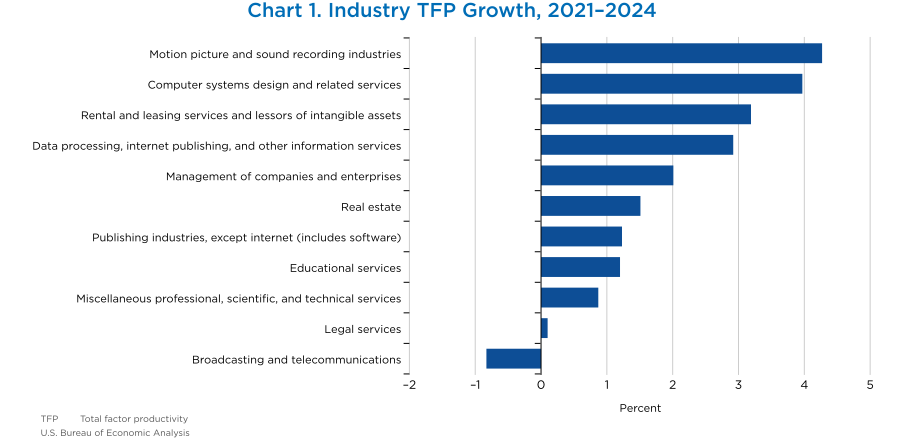
[View larger chart]
Chart 1 tabulates average annual TFP growth between 2021 and 2024 for the relatively AI-intensive industries as defined in Highfill and Samuels (2026a).13 These industries all reported AI use in the top quartile in comparison to the other industries that span the U.S. economy. Nine of the 11 AI-intensive industries had TFP growth that was faster than aggregate TFP growth over the period. Importantly, the tabulations related to AI do not imply causality, i.e., there are no claims that AI caused these productivity improvements. But measured TFP increases may be related to process improvements, restructuring productive activities, or other forms of innovation that are related to AI. For example, if the computer systems design industry has been able to make effective use of AI, whether it is to produce innovative products or to produce more efficiently, this would be reflected in its measured TFP increase. Importantly, as discussed in Highfill and Samuels (2026a), AI use may not be directly measured as input to production (some may be embedded in paid software purchases), so increases in measured TFP in AI-intensive industries may be an indicator for where direct measures of AI use may be lacking. The TFP increases for other AI-intensive industries are compelling as well, and while there is not sufficient data to tie these results to AI, there are some potential mechanisms where analysis can start to search for these links. For example, publishing is another high-tech industry because it includes prepackaged software. Therefore, AI-led software development may be driving the TFP measures in that sector. Relatedly, data processing and internet publishing includes cloud storage and web portals, which have direct connection to the development and provision of AI. But there are also potential connections between AI and nontraditional tech companies. One example is the motion picture and sound recording industry. This is an industry that both relies on technology to produce content but also makes use of inputs that may be impacted by AI, like marketing. As noted above, the result for the real estate industry may involve data consistency issues because it includes owner-occupied housing. Nevertheless, one could envision many potential uses for AI within the sector, so it is not possible to rule out the TFP increase is related to AI.
Industry-level data, within an integrated production account framework, are important for analyzing the drivers of economic growth and the sources of structural change in the economy. The full set of industry tables that can serve as a starting point for such analysis are available on BEA's website.
Fleck, Susan, Steven Rosenthal, Matthew Russell, Erich H. Strassner, and Lisa Usher. 2014. “A Prototype BEA/BLS Industry-Level Production Account for the United States.” In Measuring Economic Sustainability and Progress, edited by Dale W. Jorgenson, J. Steven Landefeld, and Paul Schreyer, 323–372. Chicago: University of Chicago Press, for the National Bureau of Economic Research.
Garner, Corby, Justin Harper, Tom Howells, Matt Russell, and Jon Samuels. 2018. “Integrated Industry-Level Production Account for the United States: Experimental Statistics for 1987–1997, Revised Statistics for 1998–2015, and Initial Statistics for 2016.” Survey of Current Business 98 (July).
Garner, Corby, Justin Harper, Matt Russell, and Jon Samuels. 2020. “Integrated Industry-Level Production Account for the United States and the Sources of U.S. Economic Growth Between 1987 and 2018.” Survey of Current Business 100 (April).
Garner, Corby, Justin Harper, Matt Russell, and Jon Samuels. 2022. “Integrated BEA/BLS Industry-Level Production Account: Statistics for 1987–2020 and a Retrospective Look at How the COVID–19 Recession Compared to the Great Recession.” Survey of Current Business 102 (June).
Highfill, Tina and Jon D. Samuels. “Early Estimates of the Impact of AI Within BEA's Industry Economic Accounts.” Working paper no. WP2026–3. Washington, DC: U.S. Bureau of Economic Analysis, February 2026, https://doi.org/10.66137/PEVZ1322
Highfll, Tina, and Jon D. Samuels. Early Evidence on the Relationship Between AI, Costs, and Prices Within BEA's Industry Economic Accounts. Working paper no. WP2026–8. Washington, DC: U.S. Bureau of Economic Analysis, April 2026, https://doi.org/10.66137/MTMU7995
Jorgenson, Dale W. 1996. “Technology in Growth Theory.” Paper presented at the Federal Reserve Bank of Boston at the Technology and Growth Conference Series No. 40, Boston, MA, June.
Jorgenson, Dale W., Frank Gollop, and Barbara Fraumeni. 1987. Productivity and U.S. Economic Growth. Cambridge, MA: Harvard University Press.
Jorgenson, Dale W., Mun S. Ho, and Kevin J. Stiroh. 2005. Productivity Volume 3: Information Technology and the American Growth Resurgence. Cambridge, MA: MIT Press.
Jorgenson, Dale W., Mun S. Ho, Jon D. Samuels, and Kevin J. Stiroh. 2007. “Industry Origins of the American Productivity Resurgence.” Economic Systems Research 19 (October).
Jorgenson, Dale W. and Zvi Griliches. 1967. “The Explanation of Productivity Change.” The Review of Economic Studies 34 (July).
- Garner and Russell are with the U.S. Bureau of Labor Statistics Office of Productivity and Technology. Harper and Samuels are with the U.S. Bureau of Economic Analysis National Economic Accounts Directorate.
- The ILPA and integrated TFP measures presented in this article reflect output consistent with GDP for the total economy but differ in concepts and coverage from the official U.S. TFP measures from BLS, which are available on the BLS website. With the May 2022 update, the terminology “multifactor productivity” was replaced by “total factor productivity.” This was a change in terminology only, with no changes in concepts or methods, following a decision in the BLS Productivity Program.
- See “Information on 2025 Annual Updates to the National, Industry, and State and Local Economic Accounts” on the BEA website.
- See the release “Revised Total Factor Productivity for Major Industries — 2024” on the BLS website.
- Aggregate results are built up from the industry-level measures contained in the account. Aggregation over industries is discussed in Jorgenson et al. (2007).
- The underlying detail used to measure capital corresponds to the classification in BEA's fixed asset accounts (over 90 nonresidential fixed assets), plus land and inventories.
- At the industry level, intermediate inputs are accounted for directly, but at the aggregate level, domestically produced intermediate input across the entire production chain is ultimately attributed to either capital or labor. Thus, at the aggregate level, the value of domestic production equals payments to aggregate capital and labor services.
- The underlying detail used to measure labor cross-classifies workers by level of educational attainment, age group, sex, and industry, but the published detail is aggregated over these groups.
- A contribution is defined as a nominal share-weighted growth rate. Thus, a fall in hours multiplied by the group's share results in a negative contribution.
- For example via outsourcing, capital investment or improved efficiency.
- An industry contribution to aggregate TFP is its Domar-weight times TFP growth in the sector.
- The choice of where to split the sample impacts exercises like this. This 2021 break point is chosen because AI entered the zeitgeist in 2022. Therefor, the 1997–2021 period includes the end of the IT boom, the Great Recession and recovery, and the covid recession and recovery.
- The year chosen in Highfill and Samuels (2026a) as the year AI entered the mainstream was 2022.
Suggested citation
Corby Garner, Justin Harper, Matt Russell, and Jon Samuels, “Integrated BEA-BLS Industry-Level Production Account, 1997–2024: The Sources of U.S. Economic Growth During the Expansion of AI,” Survey of Current Business (April 27, 2026), https://doi.org/10.66137/RQJM3955.
